Emma Watson Speaks Candidly on Acting, Red Carpets and J.K. Rowling in Rare Interview
Emma Watson was remarkably candid during her first significant interview in a long time.
The acclaimed star, known for her role in Harry Potter, unexpectedly featured on Jay Shetty’s “On Purpose” podcast this past Wednesday, September 24. She delved into various topics, including her choice to retreat from public life and the current state of her connection with the often-debated author J.K. Rowling.
“I will never declare that I’m giving up acting,” stated Watson, 35, in the podcast episode. “My identity will forever be that of an actor. I remain receptive to returning to it.”
The last time Watson performed onscreen was six years prior, portraying Meg March in the 2019 film Little Women, subsequently stepping away from public attention. The actress achieved widespread recognition as Hermione Granger in the Harry Potter film series, spanning from 2001 to 2011, though her subsequent professional experiences differed from her initial expectations.
Is Emma Watson Continuing Her Acting Career? The 'Harry Potter' Star Offers an Infrequent Personal Insight
“In those professional settings, most individuals aren't seeking companionships,” she remembered. “I found the lack of connection quite distressing. It felt highly unique to have spent 12 years creating a film series where we formed a close-knit group.”
Watson admitted she felt “insane” for abandoning a profession so “highly regarded” — yet, it was a necessary step for her.
Continue reading for the most significant disclosures from Watson’s discussion:
Her Reasons for Leaving the Hollywood Scene
A pivotal moment in Watson’s professional journey occurred during the filming of Beth March’s demise scene in Little Women.
“I understood that I was tapping into personal struggles that I was actively recovering from, and I didn’t wish to repeatedly re-engage with them for the sake of performing some of the more demanding, unsettling, or melancholic scenes I was required to do,” she explained. “I recognized that I thought, ‘I'm unsure if it's truly beneficial for me to continuously revisit these experiences,' or if I want to employ them in my craft.”
Watson further mentioned a significant change that took place when she began collaborating with different colleagues.
“I approached those film sets carrying an expectation, which I believe I had formed during Harry Potter, that … my fellow cast and crew would become like family, and that we would maintain friendships for life,” she revealed. “I went to work seeking companionship, and that proved to be a deeply hurtful encounter for me beyond the Harry Potter productions and within the Hollywood industry.”
Watson shared that the absence of camaraderie on movie sets was incredibly tough on her. “It devastated me,” she continued, visibly moved.
Forming Relationships in the Entertainment Industry
Watson elaborated on her challenges within Hollywood, offering more insight into the scarcity of genuine friendships.
“When you're promoting major films, you're inevitably asked, ‘Do you all spend time together on set, and are you friends?’ And everyone tends to nod affirmatively. However, the reality is, no one has met outside of their professional commitments,” she confessed. “The filming schedule is incredibly demanding. Everyone is so exhausted that any free moment is spent rushing back to a hotel room to snatch whatever bit of rest is attainable.”
She continued, “Friendships demand investment of time, mutual trust, and active engagement, elements which seldom materialize. They can, and sometimes do, emerge, but it’s more akin to a rare celestial event than a regular occurrence.”
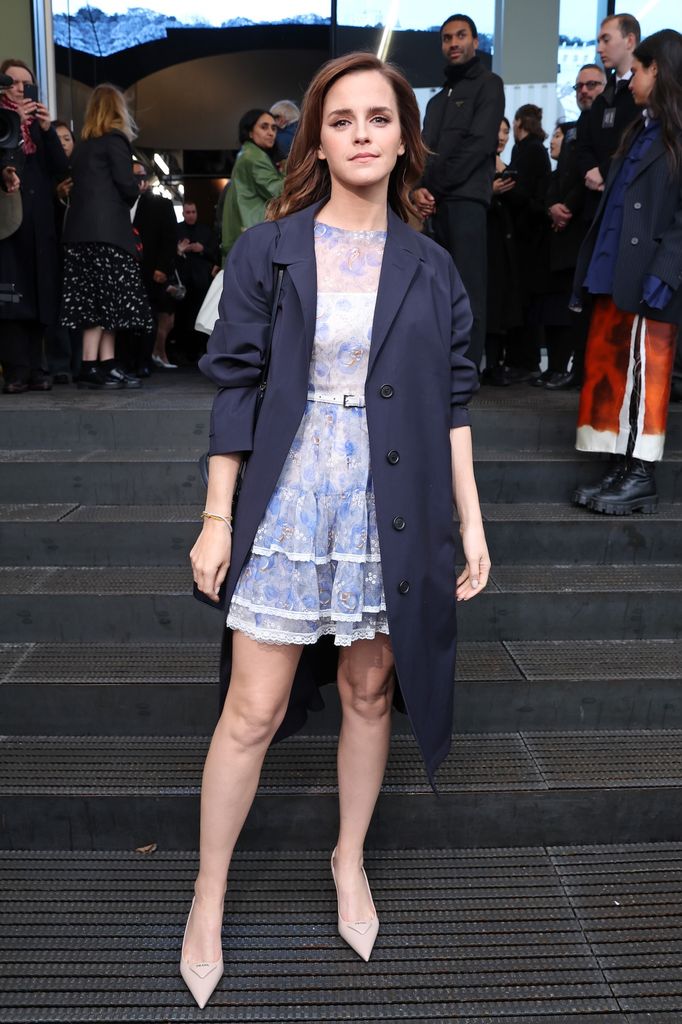
Witness Emma Watson's Remarkably Chic Red Carpet Style Progression
Unveiling the Reality of Red Carpet Events
Watson asserted that at prominent events, “every fiber of your being signals that something is amiss” due to the “overwhelming sensory input.”
“Despite being adorned in an exceptionally elegant gown and attending for an exhilarating purpose, I believe nothing can diminish the strangeness of people yelling at the top of their voices,” she remarked. “One is compelled to feign that this is entirely ordinary and that you remain unaffected.”
She stated that it's “virtually unfeasible” not to perceive oneself as “mentally unstable” in such circumstances.
Embodying Hermione
Prior to trying out for the part that brought her renown, Watson was already an admirer of Rowling’s literary collection.
“It wasn't primarily about performing; rather, the books held immense personal significance for me,” she explained. “I consistently identified with Hermione. I was certain I wasn't trying out for any other character; I knew it was her. I can't quite articulate it. There was just a sense of rightness about it.”
Defining Emma Watson
The performer confessed that she evolved into a “representation” of herself during her tenure in the entertainment industry.
“This persona had been replicated countless times and was burdened by so many diverse elements. It almost felt too cumbersome to bear. I thought, ‘I'm not even sure if I can embody that demanding figure any longer,’” Watson shared, recounting a previous date where her companion remarked, “Emma Watson makes me nervous” — a sentiment she echoed.
“I am unable to even portray her,” she stated. “I lack the understanding of how to be her.”
Insights into Her Romantic Life
Watson revealed that it can feel “depersonalizing” when she's on a romantic outing and her identity is recognized.
“Witnessing a person’s demeanor drastically alter and shift can be a disorienting sensation,” she commented. “I find comfort in knowing that, at the very least, dating for everyone is largely an utter mess and unscripted free-for-all. In that regard, I feel like I'm not alone.”
Watson additionally asserted that “societal pressure is being exerted upon us” to marry.
“I'm simply content not to have experienced divorce thus far. That might sound like quite a pessimistic response,” she noted. “Perhaps I will never merit it. I wish for it to occur for me, but I don't feel it's an inherent right.”
Her Perspective on J.K. Rowling
Watson openly addressed Rowling’s contentious statements throughout the years. (The Harry Potter creator has regularly garnered media attention for anti-transgender comments, prompting several of Watson’s fellow actors to publicly oppose the offensive remarks.)
“I genuinely don't think that having gone through that journey and holding the affection, encouragement, and beliefs I possess, signifies that I cannot and do not value Jo and the individual with whom I shared personal moments,” she expressed. “I will never accept that one invalidates the other, or that my personal interactions with her are something I'm prevented from preserving and holding dear, returning to our earlier discussion.”
She continued, “My profoundest desire is that individuals who don't concur with my viewpoints will still care for me, and that I can persist in caring for those with whom I don't necessarily share identical perspectives. I believe this is an exceptionally crucial approach for me to navigate life.”
Celebrities Who Have Publicly Denounced J.K. Rowling Following Anti-Transgender Stances: Including Bowen Yang
Her primary source of “distress” was the apparent lack of effort to engage in dialogue. Watson affirmed that she would “always” be willing to communicate.
“My intention is simply to avoid making statements that further fuel a genuinely harmful public dispute and discussion, which is perhaps why — indeed, it is why — I refrain from commenting or from continuing to do so,” she explained further. “This isn't due to a lack of concern for her or the subject matter, but because the prevailing manner of this discourse feels genuinely distressing to me.”
Watson stated that it's “inconceivable” for her to disregard the profound influence of Rowling’s creations.
“Her benevolence and reassuring remarks, along with that unwavering support … and candidly, as a young woman, for her to have penned that character, brought that universe into being [and] afforded me an unparalleled chance that, truthfully, is scarcely found in the annals of English literary history,” she expressed. “It is simply impossible for me to ever dismiss her or invalidate that contribution for any reason. It must be acknowledged as truth.”
She concluded, “I am capable of loving her. I recognize her affection for me. I can feel thankful to her. I can acknowledge the veracity of her statements, and there can simultaneously exist this entirely separate aspect, and my role, I feel, is simply to encompass all of it. But the more significant point is that her accomplishments can never be erased from my experience.”