Bosideng Makes Bold Paris Fashion Week Statement with Avant-Garde Down Jackets
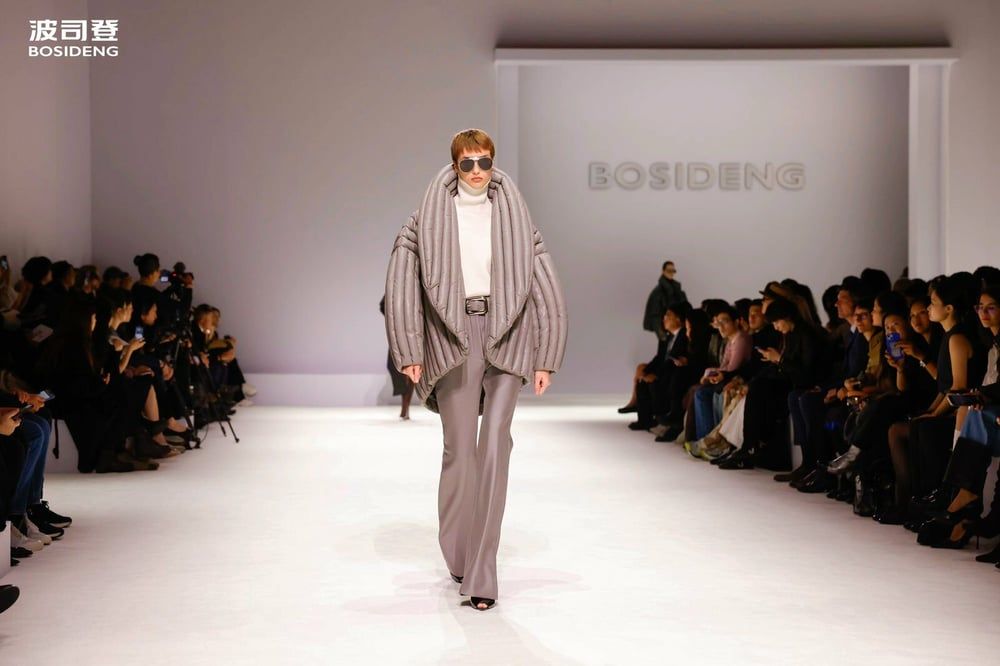
Bosideng, a Chinese fashion giant boasting sales exceeding 3 billion euros, marked its Paris debut on the final day of Paris Fashion Week. The down jacket specialist, with over 40 years of expertise, staged an off-schedule event amidst the grand columns and immense glass roof of the Palais Brongniart's main hall. This runway show signified a significant return for the brand to the City of Light, following a previous event held before the Paris Olympics at the Musée des Arts Décoratifs.
From the entrance of the former Paris Bourse, Bosideng conveyed its clear intention to firmly establish itself in the high-fashion segment. The brand presented a comprehensive timeline of its history, commencing in 1976 with outerwear production, leading to its first down jacket in 1980. This historical overview highlighted its technical advancements over the decades, particularly recent innovations like its "zero-construction approach," which introduces novel volumes to its outerwear products.
For its inaugural show in France, two years after its last appearance on the Milan catwalks, the flagship brand of the Bosideng International group presented a spectacular array of around fifty co-ed looks. The meticulously detailed three-part show was a testament to the brand's profound expertise, brimming with innovative ideas centered around the down jacket.
Pietro Ferragina, the Italian-Chinese head of style for Bosideng since 2017, articulated his ambitious vision for the Master Puff collection: to position the label as the definitive benchmark in the down jacket genre. He explained to FashionNetwork.com, "It's a new way of approaching this category, no longer just to bring comfort and warmth to people, but also to make it a real ready-to-wear piece. I think we're the only ones in the market with this approach. I wanted to give new impetus to the Puffy style with volumes but also fabric treatments and original constructions."
The collection's direction indeed diverged significantly from traditional outdoor or functional aesthetics. Following an announcement and the sound of an airliner landing, models navigated the Palais Brongniart's main hall. While down jackets were central, they were presented not as lightweight underlayers but as primary garments, characterized by abundant volume – from oversized collars to inflated lapels – creating a distinctive look and an undeniable sense of comfort. Men showcased a new preppy mood, protected by these voluminous jackets, over which jumpers in deep shades were casually tied. Young women, evoking an air of travel, appeared in short, asymmetric, floral-print ruffled dresses complemented by monochrome, high-volume nylon down jackets. They accessorized with travel pillows matching their dresses and bags crafted from acid-bright faux leather.
This "eco-leather" was a recurring motif throughout the collection, appearing in loose, flowing men's trousers, a striking camel-coloured round poncho with a high collar extending to the waist like a giant ruff, a women's aviator-style jacket, and intricate interweaves of horizontal and vertical bands. Beyond the traveller theme, Bosideng also targeted urbanites. Jackets designed with minimal panels offered a pared-back silhouette, while others featured a multitude of ultra-puffed horizontal baffles, providing modern options with significant character. Chic iterations for both men and women played with generous collars and knotted belts, some integrated directly into the garment, to accentuate the waist.
The show's final act introduced a touch of theatrical exuberance. Again employing exaggerated volumes, the collection unveiled five variations of dramatic evening gowns in profound shades of red and black. The use of matt black fabric starkly contrasted with the sculptural volume of quilted coats and trains. Hoods, capes, and cuffs were adorned with crystals, evoking the imagery of a queen of the night – a proposition clearly aimed at a discerning Chinese clientele.
Post-show, the natural question arose regarding the Bosideng group's overarching ambition for this event. Pietro Ferragina reiterated his desire to establish the brand in Paris for the long term, a sentiment echoed by Chairman Gao Dekang who congratulated the style director. Despite its colossal presence in China, Bosideng's international expansion has been cautious. Apart from a major flagship on Molton Street in London opened in 2022, proposed development projects in Milan and Paris have yet to fully materialize. Management appears to be taking a deliberate approach, likely chastened by an initial unsuccessful international foray in the 2010s that led to the closure of all its overseas activities, particularly in Great Britain.
The group's management elaborated on their cautious strategy, stating, "The internationalisation of brands goes far beyond simply exporting products or expanding distribution channels; it involves the cross-border flow and optimal allocation of various production factors, including brand influence, talent, capital, capacity and markets. Expanding a brand overseas is a complex and long-term process, requiring sustained efforts from the company in multiple areas such as strategic positioning, brand building, technological innovation and localised operations. Bosideng will relentlessly strive to grow from China's number one down jacket brand to a global leader."
Currently, Bosideng is robustly managing its expansion within its home territory, reporting a comfortable 10% sales growth for its eponymous brand in its last financial year, ending March 31, reaching nearly 17 billion yuan (2.03 billion euros). The label operates around ten distinct lines, catering to diverse customer profiles, with the Paris-featured Master Puff Collection being its most experimental in terms of style, facilitating collaborations like that with MSGM. The group generates a significant 84% of its business, almost 26 billion yuan (3.13 billion euros), from its down jacket brands, which include Bosideng, Snow Flying, and Bengen, alongside a joint venture in China for Bogner and a stake in Moose Knuckles.
Bosideng is also exceptionally active in China's digital landscape, exploring opportunities on platforms such as Tmall, JD.com, and Douyin, where it commands 21 million followers, fostering targeted engagement across its various customer profiles. The brand is heavily investing in technological developments and artificial intelligence. "We have set up an AI Lab to explore and build a new R&D model in apparel, based on AI and Big Data," the brand stated. "This gives us a competitive edge in AI technology algorithms and creative applications for down jacket design. By continuously iterating our AI algorithms, we have created a large model that truly understands the user's stylistic vocabulary. This system enables a fully digital closed loop, from design to the garment's virtual delivery."
Beyond the digital realm, Bosideng operates as a real-world manufacturing powerhouse. The group claims to have developed an intelligent factory model, boasting a "90% automation rate in key production processes." They have implemented data-driven management throughout the entire production lifecycle, from raw material warehousing to finished product dispatch, utilizing their independently developed web-based platform for the apparel industry, GiMS. This intelligent manufacturing not only boosts production efficiency but also significantly reduces the carbon footprint per product. The Chinese giant emphasizes that these technological and environmental advancements will serve as the core pillars of its growth in the coming years.
These sophisticated developments are designed to benefit its extensive network in China, which comprises almost 3,500 stores nationwide, with a third located in major cities. Bosideng manages this vast retail presence with strategic finesse, employing a seasonal store opening strategy that ensures optimal relevance in terms of locations, with some 1,500 points of sale operating in this format annually. However, a closer look at the group's business reveals that international sales amounted to only 1 billion yuan (130 million euros) in its last financial year, marking a 28% decrease. Notably, neither the American market nor Europe featured prominently in the strategic plans announced by the group's management last March. Thus, like many Asian players seeking global visibility during Fashion Weeks, Bosideng's primary objective this autumn was likely to reinforce its brand appeal and strengthen its connection with customers in its flourishing home market.