Fashion Wholesale Reimagined: Shorter Lead Times, Smarter Collections, and AI Drive 2026 Resurgence
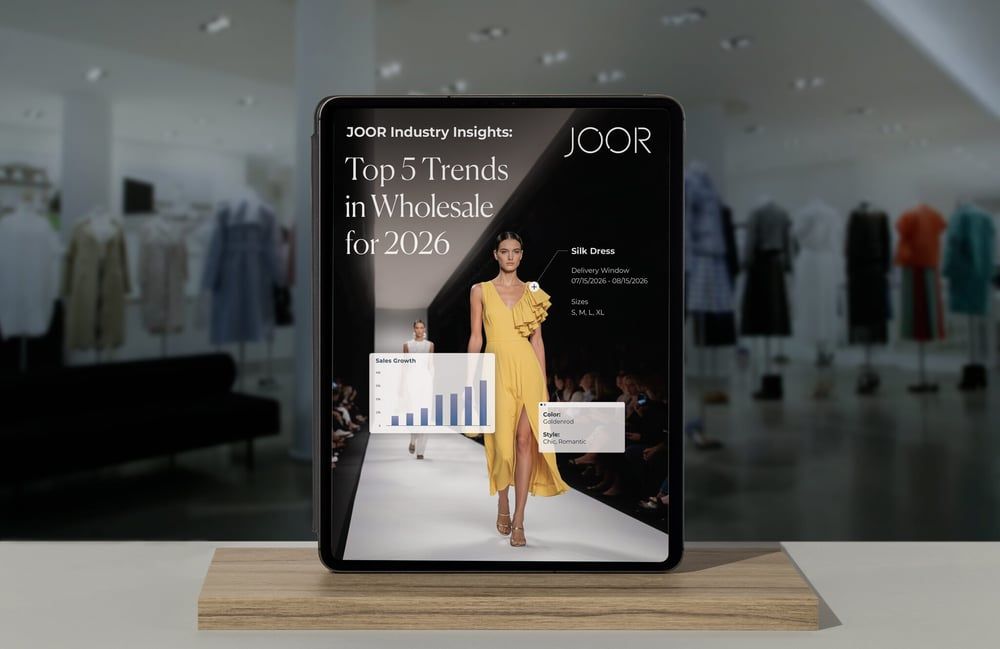
The fashion industry navigated a challenging 2025, yet as 2026 approaches, the wholesale channel is poised for a significant transformation. New data from Joor, a New York-based B2B platform connecting premium brands and retailers, indicates a strong resurgence in fashion wholesale, marked by shorter order lead times, a shift towards tighter collections featuring more evergreen products, and an increased adoption of AI tools by both retailers and brands.
Joor's insights are derived from an extensive analysis of industry transactions conducted in 150 countries, involving 675,000 retail buyers and over 14,000 brands. This comprehensive data set has allowed Joor to pinpoint five primary trends reshaping the wholesale landscape. Crucially, the first trend reveals that the wholesale channel is far from obsolete. A striking 52% of respondent brands identify wholesale as their most profitable distribution channel, outperforming both direct physical and online retail. Furthermore, wholesale currently accounts for 57% of the total revenue generated by the brands surveyed, signifying a strategic return to foundational distribution methods.
Amanda McCormick Bacal, senior vice-president of marketing at Joor, emphasizes that "the overarching theme for brands and retailers is to focus on agility and informed decision-making." She further notes that the identified trends necessitate a strategic approach built upon real-time insights, highlighting the need for dynamic responses to an evolving market.
A second significant finding from Joor's data points to increasingly demanding buyers, particularly regarding lead times. The average duration from placing a wholesale order to product shipment has dramatically decreased, plummeting from 263 days in 2019 to just 102 days in 2024. This drastic reduction signals a strong shift towards in-season buying, a trend expected to intensify in 2026 as retailers actively seek to mitigate the risks associated with unsold inventory.
This heightened risk aversion is also profoundly influencing collection composition. Brands are moving away from extensive assortments in favor of tighter, more curated collections. Over the past two years, Joor's market surveys show that the proportion of brands developing capsule collections has nearly doubled, rising from 19% to 37%. Concurrently, the focus on developing and ordering evergreen products is proving instrumental in minimizing uncertainty for both brands and buyers. Evergreen styles have grown substantially, increasing their share of Gross Merchandise Value (GMV) on Joor from 37% in 2019 to 49% in 2024. This growth underscores a buyer preference for reliable products and indicates how design creativity is adapting to commercial realities.
Joor's analysis also reveals a significant shift in client demographics. While department stores remain important showcases, independent retailers are now the primary drivers of growth. Their share of wholesale transactions on Joor has surged from 49% in 2020 to 62% in 2025. This trend is particularly pronounced in the EMEA (Europe, Middle East, and Africa) and APAC (Asia-Pacific) regions, where independent retailers and concept stores collectively account for 74% of sales volume in EMEA and 78% in APAC.
Finally, the fifth key trend shaping the wholesale channel's evolution is the escalating use of Artificial Intelligence (AI). AI technology is evolving from a tool for merely driving operational efficiency to a powerful strategy for unlocking significant growth. As brands and retailers increasingly integrate AI across various stages of their business operations, Joor itself has embraced this technology. An example is its Studio Services platform, which leverages AI to generate custom virtual models, catering to a diverse range of body types, ages, and styles, thereby enhancing the digital wholesale experience.