HTC Bets on Open AI to Disrupt Smartglasses Market
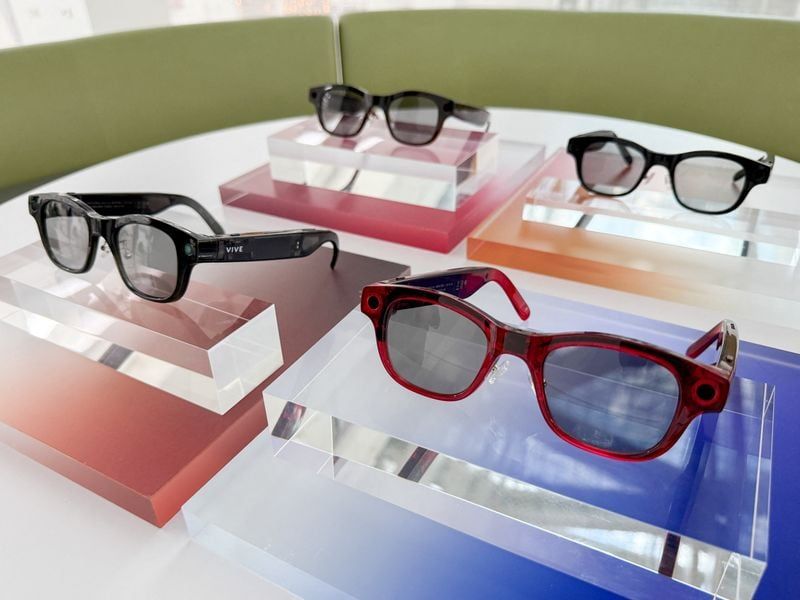
Taiwanese tech giant HTC is making a significant play in the burgeoning smartglasses market with a new strategy centered around an open platform approach. Unlike competitors who are building closed ecosystems around their own AI models, HTC’s newly launched AI-powered eyewear allows users to select and utilize the AI model of their choice.
According to Charles Huang, HTC’s senior vice president of global sales and marketing, the rapid advancement of artificial intelligence, particularly in large language models, necessitates a collaborative rather than competitive approach. “AI is advancing very fast, and large language model developers are engaged in an arms race that requires massive resources,” Huang explained in a Reuters interview. “We want to leverage the strengths of different platforms instead of building a closed ecosystem.”
The VIVE Eagle smartglasses currently support multiple AI platforms, including Google’s Gemini and OpenAI, giving users access to the latest improvements and capabilities across various models. This contrasts with Meta’s smartglasses, which rely solely on Meta AI, and offerings from Chinese brands like Xiaomi and Alibaba, which are built around domestically developed AI.
HTC recently launched the VIVE Eagle in Hong Kong, priced at HK$3,988 (approximately $512). The company plans a phased rollout, beginning with Japan and Southeast Asia in the first quarter of next year, followed by expansion into Europe and the US in late 2026. This “Asia-first” strategy is deliberate, Huang noted, as many existing smartglasses are designed with a “Western fit” that may not be comfortable or suitable for Asian facial structures.
Regarding potential entry into the Chinese market, Huang acknowledged its complexity. Restrictions on foreign AI services and stringent local data regulations requiring in-country servers present significant hurdles. “With all these requirements in place, we need to be cautious and it will take some time to prepare,” he stated.
The smartglasses market is experiencing rapid growth, with global shipments increasing by 110% in the first half of the year. However, Meta currently dominates the market, holding a 73% share according to research firm Counterpoint. Meta’s smart Ray-Bans and Oakleys, developed in partnership with EssilorLuxottica, have gained considerable attention for features like call answering, photo capture, and music playback.
Despite the excitement, analysts are raising concerns about privacy implications. Meta’s use of user data to power its AI tools has drawn scrutiny regarding its data practices. In response, HTC emphasizes its commitment to user privacy, stating that user data is not used to train its AI models and highlighting data security as a key differentiator.
The launch of the VIVE AI smartglasses represents a renewed focus for HTC on consumer hardware, following the sale of a portion of its extended reality headset and glasses unit to Google for $250 million earlier this year. This move signals HTC’s intention to re-establish itself as a key player in the evolving landscape of wearable technology.