Japanese Fashion Takes Paris by Storm with Groundbreaking Designs
Paris Fashion Week once again saw Japanese leading fashion houses make a significant impact, particularly during the sixth day of the women's ready-to-wear shows for spring-summer 2026. Three of Japan's most emblematic labels—Junya Watanabe, Noir by Kei Ninomiya, and Comme des Garçons—showcased their latest collections, offering diverse and groundbreaking visions. On the same day, Elie Saab presented a powerful collection focused on the modern urban woman.
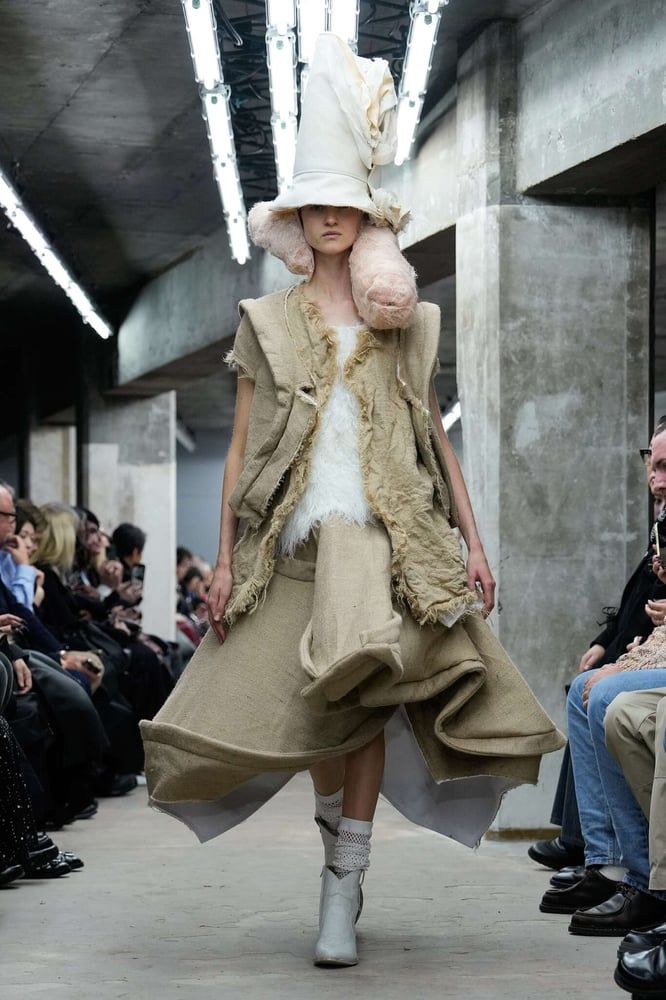
Among the Japanese presentations, Rei Kawakubo's show for Comme des Garçons proved to be the most moving and left the deepest impression. In a world grappling with continuous catastrophes and human tragedies, the designer appeared to seek a return to origins, emphasizing a reconnection with the fundamental values of the Earth. The ambiance was set with folk songs and traditional tunes accompanying a procession of models.
The collection featured amorphous, swollen silhouettes, draped in vast swathes of rustic materials like burlap, hemp, or linen, often hastily knotted. Old lace sheets, curtains, and bedspreads were also repurposed, while some jackets seemed to be cut directly from large beige canvas sacks typically used for storing agricultural produce. A waistcoat and coats made of goat hair further enhanced this primal, rustic aesthetic.
These sculptural garments, meticulously crafted through layering, volume, and padding techniques, imbued the entire collection with a sense of solemnity. Models wore battered top hats and cotton-wool hair in soft pastel shades, evoking the imagery of rag dolls or ancient cloth puppets. They brought to mind the figures of old crones or witches, traditionally burned in the countryside in January to signify the passing of the old year and the welcoming of a richer, more auspicious new season.
Junya Watanabe, known for his experimental approach, pushed creative boundaries even further this season. He delivered a breathtaking collection characterized by constantly reinvented constructions and unexpected intrusions of everyday objects. With remarkable ease, the Japanese designer integrated ordinary elements of the textile universe and daily life—items that typically go unnoticed—into his high-fashion creations.
The result was a blend of the surreal and the playful. Old white lace parasols unfurled like a corolla at the hem of a summer dress, while a cluster of straw hats formed a ruffled volume around the collar and shoulders of a long evening gown in nude-colored guipure lace. Bright red pumps surprisingly adorned the shoulders of a black sheath dress, and a cascade of metallic cutlery became the sleeves of a crinkled silver nylon T-shirt. Rendered in gold, knives and forks created intriguing sculptures on a shoulder or flank. The collection was completed with the iconic coat hanger, which served as a structural element with trench coats, shirt dresses, and polka-dot dresses threaded two or three at a time and secured to either side of the body.
At Noir, Kei Ninomiya continued his exploration of three-dimensional structures through a mathematical lens. He achieved fairytale-like, sculptural ensembles by infinitely multiplying elements as modules, such as flowers, stars, or metal cones. The show commenced with a series of pristine white tulle petticoats paired with sparkling, silver, carapace-like tunics. Models' faces were often masked or obscured by bulky headdresses, reminiscent of aggregates of quartz crystals or other organic forms. While primarily presented in black and white, these creations also appeared in unexpected fluorescent hues like pink, orange, and yellow.
Paradoxically, beneath this whimsical and avant-garde exterior lay a rather classic, almost retro wardrobe. This included prim white blouses, black balloon or pleated skirts, and suits featuring gathered ruffles. The ensembles were completed with platform moccasins, elevated by a platform and fitted with a small stiletto heel. These outfits were dramatically enhanced by harnesses or cage tunics slipped over the garments, to which an array of spectacular structures were attached: a giant star covered in precious stones, a basket-dress-shaped grid formed by a Meccano-like chain, ethereal clouds of tulle, shimmering garlands, and delicate fabric petals.
Elie Saab presented a distinct change of register, shifting the mood to evoke the electric atmosphere of bustling metropolises. The show opened in darkness, with the echoing sound of heels on pavement, as silhouettes emerged from a fog bathed in a ruddy glow, setting a "Bright Lights, Big City" tone. The collection focused on the modern working woman, embodying chic and tailored elegance.
The Elie Saab woman was presented in sophisticated pieces like chic tailored suits, pencil skirts with back slits, silk blouses with plunging necklines, and delicate polka-dot tops. She was equally at ease in pleat-front trousers as in a strapless python-skin dress, and exuded unparalleled elegance in a flowing camel trench slipping over her skin, or a jacket and T-shirt paired with sensual, floaty silk trousers with a denim effect. Her favorite styling technique was mix & match, effortlessly combining Prince of Wales check with polka dots, a leather skirt with a metallic-fringed tank top, or a worn leather jacket with an openwork sequinned skirt. For evening, the Elie Saab woman commanded attention with glittering draped maxi dresses or shorter dresses featuring dramatic long trains.