LVMH and UNESCO Renew Eco-Pact, Tiffany Joins Fight for Biosphere Reserves
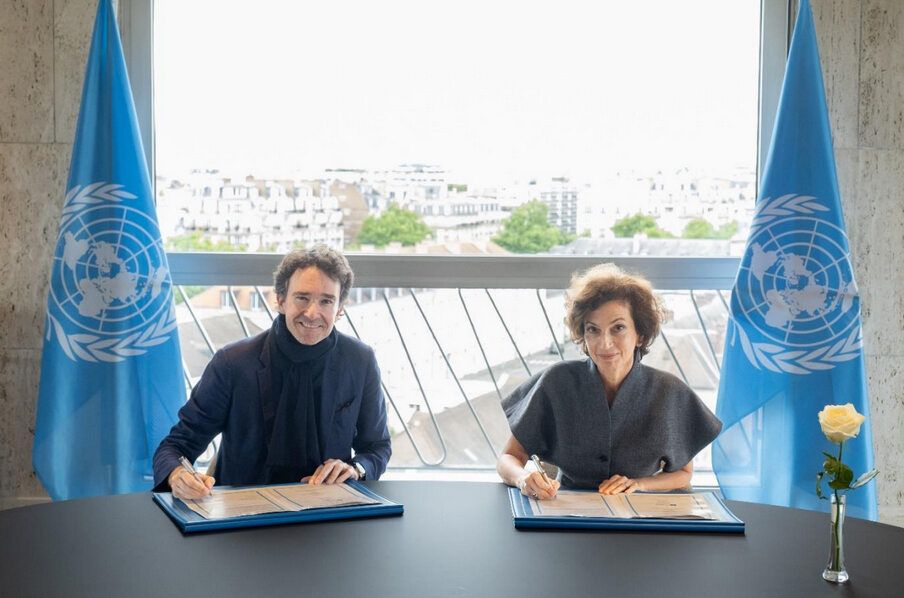
LVMH and UNESCO officially renewed their five-year partnership on October 30, solidifying a collaboration that began in 2019 under the Group’s Life 360 environmental program. This agreement is designed to bolster the implementation of the vital "Man and the Biosphere" (MAB) Program, focusing on the preservation and restoration of ecosystems within UNESCO-recognized biosphere reserves worldwide. The renewed partnership, extending from 2025 to 2029, was formally signed by Antoine Arnault, LVMH Image and Environment Director, and Audrey Azoulay, UNESCO Director-General. Through this extended commitment, LVMH pledges to intensify its efforts in supporting biodiversity through research, awareness campaigns, and sustainable local development initiatives, particularly in new geographical regions.
Reflecting on the initial five-year phase, Hélène Valade, LVMH’s Environmental Development Director, highlighted the partnership's focus on biodiversity preservation across eight UNESCO-designated areas in the Amazon, spanning Bolivia, Ecuador, Peru, and Brazil. Valade emphasized the intrinsic link between LVMH's products and nature, making biodiversity a fundamental concern. A cornerstone of their approach, developed with UNESCO, is the principle that effective biodiversity protection is inseparable from the well-being of local communities. To facilitate this, a sophisticated geospatial platform has been developed, integrating scientific expert data with invaluable insights from local communities. The program’s comprehensive strategy included targeted training, strengthening local activities, and meticulously measuring the impact of their interventions, a successful methodology now being replicated across all projects under the expanded partnership.
The new phase of this strategic partnership sees Tiffany & Co. joining the initiative, aligning its "Delivering a Healthy Ocean" program with the collective mission to protect marine and coastal ecosystems while fostering scientific research. On the ground, the partnership's impact is already visible through pilot projects across Africa, Asia, and South America. A prime example is the program dedicated to restoring the Tonlé Sap biosphere reserve in Cambodia, where LVMH actively supports reforestation efforts, promotes sustainable water management practices, and facilitates the development of economic activities that are in harmony with the local ecosystem. These projects are integral to LVMH’s overarching Life 360 commitments, which place the preservation of the living world at the core of the Group’s environmental strategy.
This environmental strategy continues to gain significant momentum within the Group, as affirmed by the president of LVMH’s CSR Observatory, who noted its ever-deepening roots in the company’s DNA. Beyond its UNESCO collaboration, LVMH is actively implementing new tools to further refine its environmental strategy and embed sustainability across its 75 Maisons. Marking a decade since the Paris Agreement and COP21, the luxury giant has demonstrated substantial progress in its direct operations, notably increasing the share of renewable energy in its energy mix from a mere 8% in 2015 to an impressive 71% in 2024. Furthermore, impact measurement indicators are now seamlessly integrated into the daily practices of its teams, reflecting a profound shift in operational philosophy.
To achieve even greater environmental impact, LVMH recognizes the critical need to address Scope 3 emissions, those generated across its extensive supply chain. To this end, the Group is pursuing several ambitious initiatives in parallel. A pivotal moment occurred on September 17, with a groundbreaking meeting that brought together the environmental responsibility directors and finance directors from across its Maisons. Hélène Valade described this as an "extremely powerful moment" aimed at forging a cross-functional finance-sustainability approach, bridging terminologies with practical aspects such as financially approaching a climate transition plan. This collaborative effort culminated in the decision to establish a dedicated sustainability-finance task force.
The newly formed task force is charged with developing a robust financial framework to assess and manage climate and biodiversity risks for LVMH. This includes quantifying the financial implications of climate inaction and identifying supply chain vulnerabilities in line with IPCC scenarios. Crucially, the task force will also be responsible for creating a framework for investment capacity based on stringent environmental criteria. Recognizing the sensitive nature of supply chain oversight, particularly in the luxury sector following recent scandals, LVMH also convened 120 of its key suppliers last spring. This gathering was designed to raise awareness regarding the profound challenges involved in transforming business models.
Hélène Valade emphasized LVMH’s commitment to supporting its suppliers, stating, "They are our Scope 3, so we need to look after them and support them in their environmental transition." She advocated for an incentive-based model over punitive sanctions, fostering a spirit of co-creation. Suppliers, while aware of environmental issues, often face significant administrative burdens and complex reporting requirements. LVMH aims to alleviate these challenges, identifying innovations that benefit all parties and offering its comprehensive training programs to its partners. This collaborative approach underscores LVMH's dedication to embedding sustainability not just within its own operations, but throughout its entire value chain.