Made in France Faces Fierce Price Wars and Shifting Consumer Tastes
Fifteen years after French manufacturing became a prominent topic of public discourse, the annual MIF Expo trade show in Paris continues to spotlight the rich heritage of the country's clothing and footwear industries. This year’s event, held from November 6 to 9, opened amidst heightened market volatility, coinciding with the inauguration of a Shein boutique at BHV, signaling a new era where "Made in France" players face unprecedented pressures. Luc Lesénécal, CEO of the Normandy-based brand Saint James, observes, "The Made in France market, which had previously been spared, is now under attack," citing direct impacts from political and economic instability that have even put workshop expansion plans on hold.
The core challenge lies in an intensifying price war and shifting consumer perceptions. Patrick Mainguené, director of the Ardèche-based footwear brand Ector, highlights the extreme disparity: "In September, I saw trainers being sold in a supermarket for €4.99," a price equivalent to their soles alone. Competing at such levels is impossible, even with Asian sourcing, once transport and logistics are factored in. This makes explaining a €120 price point a hard sell for many consumers. Julien Tuffery, head of jeans brand Atelier Tuffery, laments that while the share of customers exclusively buying Made in France is growing, it's being "stifled by the incredible growth in people buying shoddy clothes." Fabienne Delahaye, founder of MIF Expo, encapsulates the broader dilemma, asking, "It’s time to ask ourselves the real question: do we want to be a nation of passive consumers or a nation of responsible producers?"
In this challenging landscape, French manufacturers differentiate themselves not by price, but by an unwavering commitment to quality and longevity. Luc Lesénécal, leading a century-old company, acknowledges, "We’ll never be competitive on price." He warns against the proliferation of low-quality, short-lifespan items, emphasizing that the true strength of Made in France lies in its superior quality and the cost spread over many years of use, unlike fast fashion items that might not survive more than two washes. Julien Tuffery concurs, stating, "This battle for volume and low prices is lost, probably forever. But I also think it’s this mediocrity that means our battle will be won. The bigger and uglier this great machine becomes, the more room it will leave for alternative paths."
Beyond the "Made in France" label itself, other factors drive purchasing decisions. Patrick Mainguené observes that while origin plays a role, "it’s not the primary one." He notes from MIF Expo experience that "what makes people stop is first and foremost aesthetics and comfort." Consumers initially gravitate towards products they like visually and feel good in. However, the expectation of high quality is intrinsically linked to French manufacturing, a point on which brands "must not disappoint" to build lasting loyalty.
Producing in France, however, presents its own set of practical hurdles, particularly concerning material sourcing. The choice of local materials is limited, and costs are often significantly higher. Julien Tuffery explains that Atelier Tuffery uses local wool, linen, and hemp, paying "very high prices for materials that we could find for a quarter of the price a little further afield." This is a necessary investment to build a "robust supply chain," and he hopes the current economic difficulties won't undo a decade of such efforts. Saint James, which maintains 70% of its premium production in France, carefully sticks to natural materials like wool and cotton, with plans for a linen Breton shirt in 2026 using yarn from a Normandy-based "French Filature."
Infrastructure and managed growth also pose significant challenges. Patrick Mainguené points out the shrinking number of footwear manufacturers in France, attributing it to vast price differences across Europe. Many French designers, he notes, are compelled to produce in Spain or Portugal, which boast "well-equipped factories," contrasting with France's "ageing, even obsolete, equipment." Industry members agree that pursuing rapid, high-volume growth in the Made in France sector is risky. Julien Tuffery states it’s an "unsolvable equation" to achieve high volume, low prices, ubiquitous distribution, and rapid growth while also delivering on CSR and quality. Saint James, despite 60% growth over the past twelve years, deliberately limits expansion to 5% annually to ensure production facilities can keep pace, investing in modernizing its knitting machines and balancing export markets to mitigate against unforeseen shocks.
Internationally, the perception of "Made in France" can vary. While French luxury fashion houses command global reverence, local manufacturers' products do not always enjoy the same immediate aura. Julien Tuffery, returning from Japan, notes with humility that "whether it’s Made in France or Italy makes no difference to them." Patrick Mainguené offers a nuanced view, suggesting that abroad, "there’s an attraction for Made in France if it conveys heritage," as is the case with iconic Breton shirts and sailors’ jumpers.
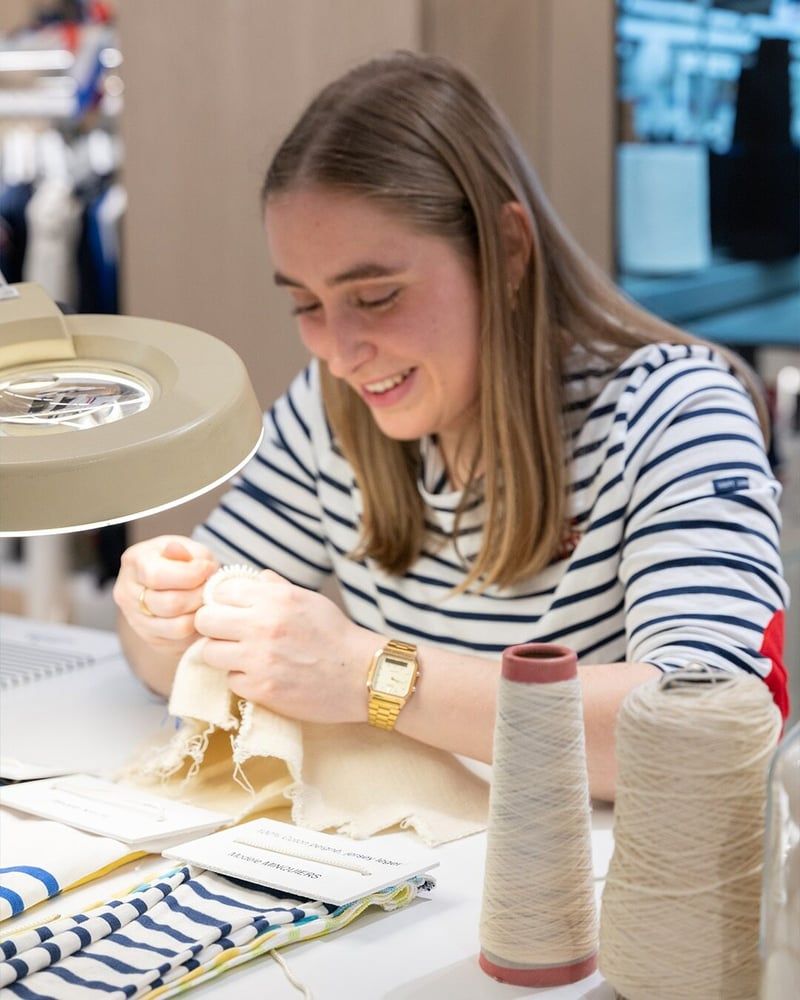
One of the most profound challenges for local production is the scarcity of skilled labor, a direct consequence of offshoring trends in the 2000s. To address this, in-house training has become indispensable across the industry. Saint James requires 18 to 24 months to train an individual for a position, while Atelier Tuffery emphasizes employee versatility and fosters a welcoming production environment that breaks from the old factory image. Patrick Mainguené underscores the critical role of desire and on-the-job learning: "People coming out of training have a basic knowledge that saves us time, but above all it’s their desire to do the job that’s decisive." He stresses the necessity of extensive in-house training, declaring, "Without that, there’s no French manufacturing."
Finally, public policy, particularly procurement, is seen as inseparable from the future of Made in France. Luc Lesénécal advocates for public contracts to prioritize French manufacturers, drawing a parallel with the US where 50% of contracts are reserved for American companies. Beyond supporting reshoring, he argues for actively promoting those who, like Saint James, "have never offshored." Such measures are crucial to reinforcing the "industrial sovereignty" championed by the Élysée in 2020, ensuring a robust and responsible production ecosystem for the nation's future.