Paris Fashion Week: From Gaultier's disaster to Celine's triumph and Valentino's familiar echo.
A recent Sunday at Paris Fashion Week presented a spectrum of sartorial experiences, ranging from an ill-fated debut at Jean-Paul Gaultier to commercially astute designs at Celine, artistic elegance at Akris, and a familiar aesthetic from Alessandro Michele at Valentino. This season notably saw many emerging designers opting for caution, adhering too closely to brand codes and DNA.
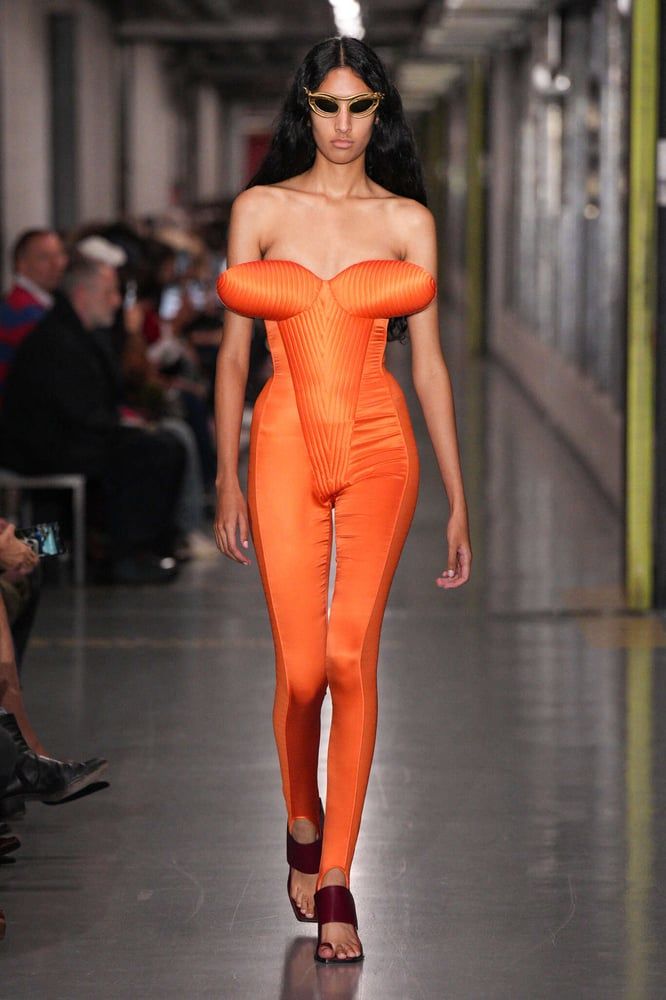
The highly anticipated debut of Duran Lantink at Jean-Paul Gaultier, however, defied this cautious trend, attempting to radically reinterpret the house's legacy. The outcome was widely described as an "unmitigated fashion disaster." Lantink engaged with many Gaultier icons, yet infused them with a cheeky, often perplexing silliness. For instance, Gaultier's innovative chiffon prints were reimagined as body stockings featuring exact body prints, disturbingly adorned with stains and blood. The legendary Madonna conical bra was transformed into a squished-boobed alien doll in orange, while JPG’s signature blue-and-white target motif devolved into an absurd molded leotard reminiscent of a Teletubbies and Target department store collaboration.
The ominous signs began even before the show, with guests navigating a dark, 80-meter corridor leading to a venue situated amidst the heating and sewer pipes of the Jacque Chirac Museum. This subterranean setting, starkly contrasting with Gaultier's renowned optimism, humor, and irreverence, was deemed profoundly unsuitable. While the Dutch-born Lantink did attempt a series of athletic looks, echoing Jean-Paul’s 'body beautiful' aesthetic, only a few managed to resonate, and even then, barely. The entry and exit point, passing a mock nightclub bar strewn with empty bottles, dirty glasses, and spent cocktails, served as a somber symbolic welcome to, and exit from, what felt like a premature end to any new party at Jean-Paul Gaultier.
In contrast, the sun seemed to shine brightly on Celine's presentation, reflecting the growing success of creative director Michael Rider, who has achieved significant traction after just two swift collections. His latest Spring/Summer 2026 offering was described as spruce, sleek, and snazzy, brimming with commercial hits that made it arguably the most buyer-friendly collection in Paris. Despite reports of Celine's business cooling after the departure of Rider's acclaimed predecessor, Hedi Slimane, this collection was packed with consumer-friendly pieces, conveying such a clear and focused message that a separate merchandiser almost seemed superfluous.
Staged outdoors along a beautiful tree-lined path in the Parc de Saint Cloud, the Celine show offered a moment of grace amidst what has been an exceptionally hectic Paris Fashion Week, marked by a debut designer show at a major house almost daily. Rider's tailoring was impeccable, skillfully blending '80s power-shoulder jackets with Spanish-style peg-leg pants that flared subtly at the ankle, showcased in a co-ed format. His cocktail dresses were short, flared, and adorned with pop-art florals, while draped blouses exhibited sculptural finesse, almost toga-like. His past tenure at Ralph Lauren was subtly evident, particularly in a bright yellow cashmere sweater featuring a Celine horseman and carriage design. Continuing a thoughtful tradition from his debut, guests received a silk scarf as a gift, and scarves emerged as a leitmotif of the show, worn as foulards, bracelets, neckties, and even adorning distinguished writers at Harry’s Bar upstairs, a deliberate contrast to Gaultier's basement setting. Footwear was also a highlight, ranging from boxing boots with vertical Celine logos to pointy mock crocodile double CC logo loafers and minimalist cowboy boots. This collection marks a second home run for the American designer at Celine, though some suggested it could benefit from a touch more soul and Parisian pizzazz.
Akris, a brand dedicated to the philosophy of dressing women rather than merely decorating them, consistently delivers collections of understated sophistication. This season, creative director Albert Kriemler drew inspiration from the influential painter Leon Polk Smith, renowned for his geometrically oriented abstract works. Smith's curving shapes and bright minimalism were masterfully translated into some truly exceptional garments, culminating in a glorious finale of unexpected wit through curlicue abstraction. The collection was presented before a colossal reproduction of one of Smith's panels, centered within a curving runway at the Palais de Tokyo, where the cast marched out with purpose. The Akris client, typically a busy, career-driven over-achiever, finds her active lifestyle catered to by these intelligently designed garments.
The show commenced with a striking wool vermillion suit, pairing capri pants with a long jacket cut with polygon panels. Other notable pieces included white cotton skirts adorned with bright orange polygon patches and a beautiful Panama silk organza parka matched with a mini skirt. Kriemler also presented second-skin leather jerkins or shirt jackets crafted from Nappa lamb, paired with denim capri pants – a versatile look designed to flatter a wide range of women. While Akris may be beyond the price range of many, it has undeniably established itself as one of the most empowering fashion labels globally over the past two decades, a claim that is no exaggeration.
Alessandro Michele’s latest show for Valentino took a distinctly somber turn, referencing the student days of Pier Paolo Pasolini during World War II. The collection was staged within an all-black tent that shuddered throughout the presentation, creating the unsettling impression of a bombing raid. A low ceiling and twisting fluorescent lights further evoked a nighttime bombing scenario or a dark Berlin nightclub – locales not typically associated with the Valentino woman. The collection itself, however, was classic Michele: a blend of retro glamour featuring high-waisted skirts split at the knee, paired with various chiffon blouses distinguished by peak shoulders and collars adorned with bows and ties.
Key pieces included an impressive violet coatdress with architectural molding and several exquisitely draped jacquard dresses. For evening wear, Alessandro explored the season's new refinement, presenting largely sheer lace columns and body stockings designed to subtly reveal lingerie. The co-ed show saw male models sauntering in remarkably well-tailored double-breasted blazers, appearing as if freshly pressed from a suitcase. Both sexes sported golden metallic embroidered garments – boleros for women, and shorts and even bowling shoes for men. Despite the party-ready attire, the cast walked with downcast expressions during the finale, accompanied by an orchestral soundtrack that felt more suited to a funeral. In his program notes, Michele referenced Pasolini’s 1941 erotic letter and a 1975 essay that warned against the resurgence of fascism, not through violence, but via "the conformism that was ravaging the values, the souls and the languages, a new night so impenetrable to completely devour the differences and the luminous dances of the fireflies seeking love." Michele's decision to raise the specter of fascism's re-emergence is commendable, especially given contemporary global socio-political concerns. However, as a fashion statement, the collection itself felt like a repetitive resurgence of designs that were, regrettably, far too familiar.