Paris Fashion Week Spring Summer 2026: Rabanne Dazzles, Carven Charms, Gauchere Moves
Paris Fashion Week once again captivated audiences with its Spring/Summer 2026 collections, revealing a spectrum of distinct design philosophies. The shows presented on Thursday highlighted markedly contrasting visions, from Rabanne's high-octane celebration of exuberance to Carven's refined elegance and Gauchere's innovative exploration of fashion in motion.
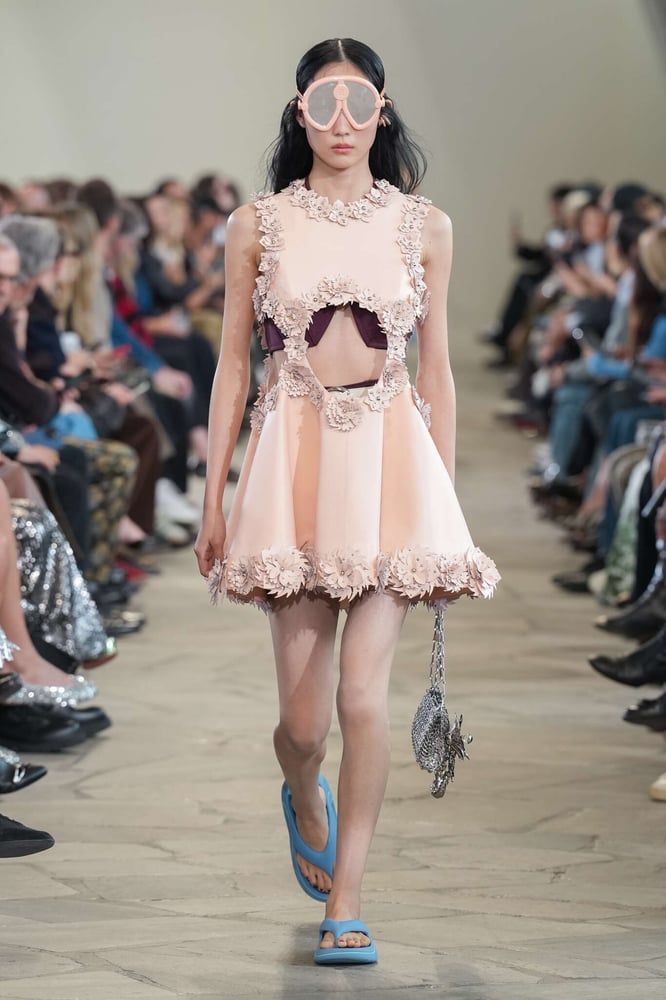
At Rabanne, creative director Julien Dossena orchestrated a spectacle of sound and sparkle within one of UNESCO’s glass-walled halls. Models moved to an electrifying soundtrack, showcasing an explosion of styles, patterns, materials, and colours. Dossena's vision centered on mix-and-match outfits for young, eccentric women eager to embrace fun and make the most of summer. Their imagined suitcases were packed with pastel-hued looks, flip-flops, neoprene trousers, and diving goggles. The bikini or bra top took a starring role, appearing supersized and rendered in various forms—lacy, embroidered, draped, or adorned with stones, crafted from technical fabric, cotton, or leather. Eye-catching porthole cut-outs, a signature detail this season, appeared at the chest and beyond, gracing dresses and neat, rounded jackets.
The Rabanne collection featured an array of seemingly disparate pieces designed to slot together with ease, inviting endless deconstruction and reconstruction for joyful clashes. Examples included a battered XXL leather gilet or a striped polo shirt paired with a gold miniskirt, and a cropped tartan shirt teamed with a crystal-studded mini. This baroque collection pulsated with motion and vibrance, adorned with bows, lace, ribbons, flouncy ruffles, appliqués, and, notably, oversized metallic flowers strung like garlands. A satin pencil skirt embroidered with pearls and finished with a giant belt buckle epitomized the collection's embrace of excess and joy, which are set to be next summer’s definitive watchwords.
Carven opened its show with a series of all-white looks, signaling a fresh start under Mark Thomas, who took the helm in March following Louise Trotter's departure. Thomas, a 49-year-old British designer already familiar with the house, explained that this collection represents "the second chapter of the new vision," continuing the minimalist, sophisticated, and wearable direction established in recent seasons, but infused with a freer, more relaxed spirit. Details like a camisole nonchalantly layered over a vest top, a silk jumpsuit strap slipping off the shoulder, and a shirt dress buttoned up at the back contributed to this ease. Most dresses, in fact, were left partially open at the upper back to subtly reveal the skin.
Mark Thomas cited "a woman in Paris in July" as the inspiration for Carven's next summer collection, presented in the courtyard of the brand's headquarters at the Rond-Point des Champs-Élysées. The garments exuded lightness, comfort, and natural elegance, dominated by a neutral palette of ecru, black, and grey, with a single pink blouse offering a touch of color. Tops, skirts, and strapless dresses appeared as if cut from old cotton sheets. Jogger-style trousers, fashioned from grey moiré or silky satin, were instantly elevated, while sheer organza skirts embroidered with tiny flowers were unexpectedly paired with parkas. Black vinyl pieces and men’s tailoring added a robust edge to this otherwise delicate wardrobe. Carven, owned by the Chinese group ICCF, maintains two boutiques in Paris and two in Shanghai, alongside approximately 50 multibrand stockists globally, including Harrods in London, Printemps in New York, and Antonia in Milan.
Gauchere opted for an intimate and emotional format this season, moving away from the traditional catwalk. Founder and designer Marie-Christine Statz welcomed guests to the brand’s headquarters on Rue de Rivoli, where she dressed five dancers in her creations for a captivating performance choreographed by Benjamin Millepied, a collaborator on previous costume projects. This innovative approach effectively showcased the functionality of Gauchere's designs, which are built on modular, mutable garments that can be adapted and reinvented with each wear. Tailoring was soft, featuring loose, deconstructed blazers that changed shape depending on how they were buttoned. Hybrid jersey tank tops doubled up, multiplying straps that criss-crossed or fell down the sides in a mirrored fashion.
Skirts and tops, composed of panels and a row of press studs, could be adjusted in multiple ways, creating diverse volumes and movements on the body. The materials themselves offered notable flexibility: recycled grey nylon with a glossy, plastic-like finish for shorts and bralettes; soft, stretchy faux leather; silk–viscose for trousers; and Japanese marbled denim used for pleated, draped jeans with a matching bralette. Marie-Christine Statz explained her vision at the conclusion of the show: "Everything plays out between construction and deconstruction, creating a shift in the silhouette. A bit like what happened in the choreography, which was performed in turn by one, then three and then five people. I wanted to go further, with a presentation different from the traditional runway show, to offer something that moves you, where you can see the garment from different angles."