Taiwan Turns Banana Waste Into Sustainable Textiles
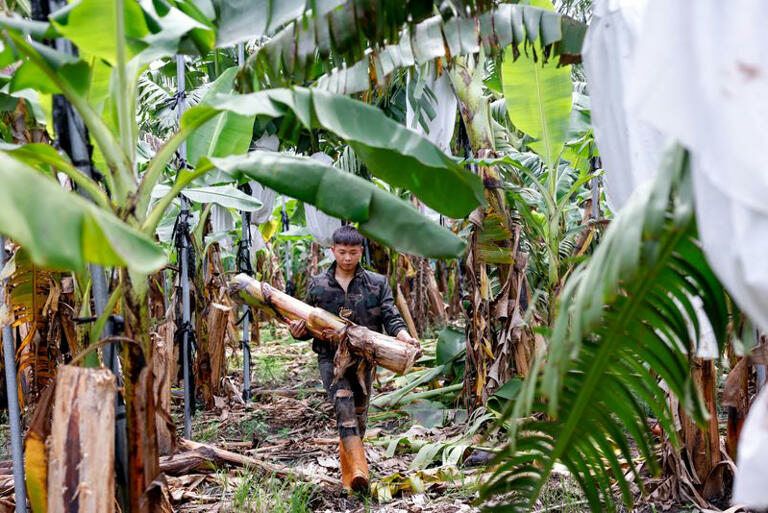
Entrepreneur Nelson Yang is embarking on an innovative journey, drawing inspiration from Taiwan's rich agricultural heritage to revolutionize the textile industry. His company, Farm to Material, based in the central Changhua rural belt, is transforming the often-discarded parts of the humble banana plant into an unlikely sustainable textile. While Taiwan is now globally recognized for its advanced semiconductor production, the yellow fruit once held a significant place in the island’s national pride and economy, a legacy Yang is now re-envisioning for a sustainable future.
The genesis of this venture dates back to 2008 when European sneaker brands approached Yang with a desire to integrate food and material production. "They were hoping to find a way for food and materials to be produced in parallel, meaning that food and materials are yielded from the same land," Yang recounted to Reuters. This concept became the guiding principle for Farm to Material. Their core mission is to source all materials from food products or agricultural and food industry leftovers, subsequently transforming these byproducts into valuable, usable materials for various applications.
Taiwan’s historical connection to bananas is deeply ingrained. During Japanese colonial rule from 1895 to 1945, the island earned renown for its abundant fruit exports, particularly pineapples and bananas. This agricultural prowess continued into the 1960s, a period when Taiwan proudly branded itself the "banana kingdom" to bolster its global exports. Although this title has long since been overshadowed by the nation's burgeoning tech industry, Yang’s initiative resurrects a piece of this patriotic past, applying modern innovation to an ancestral crop.
The technical process at Farm to Material focuses on the banana plant's middle section, known as the pseudostem. This part of the plant is typically left to decompose in the fields after the banana harvest. Yang's company intervenes by crushing and drying the pseudostem to extract its natural fibers. These robust fibers can then be processed into yarn, suitable for blending with cotton to create items like socks, or even transformed into innovative vegan leather alternatives, offering a cruelty-free and environmentally friendly option for various products.
Currently, Farm to Material is in its foundational stages, still awaiting its first orders from major apparel companies. However, Yang holds a clear vision: to one day supply these sustainable banana-based textiles to global sneaker brands, fulfilling the original inspiration that sparked his venture. This nascent business represents a significant step towards a circular economy, demonstrating how agricultural waste can be repurposed into high-value materials.
Taiwan's banana fiber initiative is not an isolated effort but rather a part of a broader global shift towards sustainable material innovation within the fashion industry. For instance, Spinnova, a European company, is already producing eco-fibers from wood or waste, establishing partnerships with major brands like Adidas and Bestseller. Concurrently, startups such as Galy are exploring lab-grown cotton, aiming to mitigate cotton’s substantial environmental footprint through controlled, less land-intensive cultivation methods. These parallel developments underscore the urgent need and growing potential for such bio-based solutions.
The advantages of banana fiber are compelling, positioning it as a highly promising material for future applications. Charlotte Chiang, director of the innovation and sustainable design department at the Taiwan Textile Federation, highlights its superior performance. "Banana fiber actually performs better than regular cotton in terms of water consumption, absorbency, and supply stability," Chiang noted. She further expressed optimism, stating that "Banana fiber could become a new highlight for Taiwan in the field of biomass fiber in the textiles industry," suggesting a new era of recognition for Taiwan's textile sector.
Through Nelson Yang's pioneering work with Farm to Material, Taiwan is not only paying homage to its agricultural roots but also carving out a forward-thinking niche in the global sustainable textile market. By transforming agricultural waste into valuable, eco-friendly materials, this initiative embodies a powerful model for resource efficiency and innovation, offering a tangible pathway towards a more sustainable and circular economy for the fashion and manufacturing industries worldwide.