Trump Administration Asks Supreme Court to Review Key Tariff Ruling
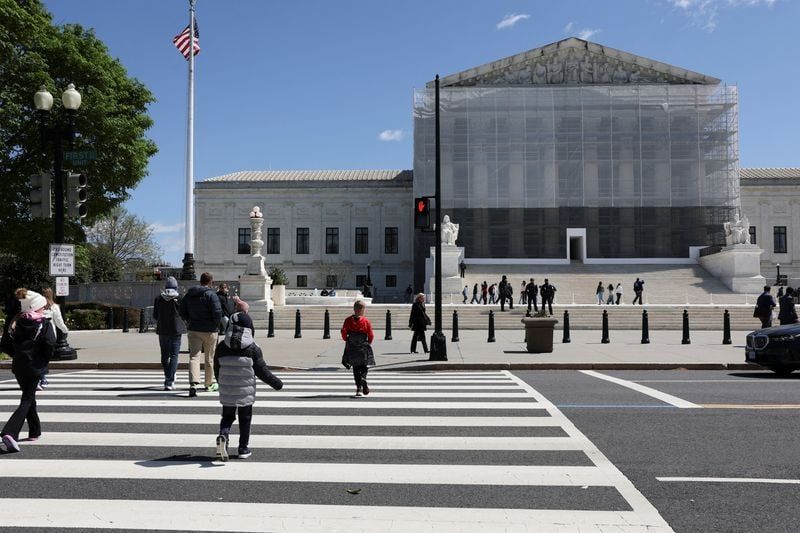
The Trump administration has formally requested the U.S. Supreme Court to review a crucial lower court decision that invalidated a significant portion of its sweeping tariffs, implemented under a 1977 emergency law. This appeal comes after a federal appeals court ruled that the former president exceeded his authority in invoking the International Emergency Economic Powers Act (IEEPA) to impose these levies, which are central to his economic and trade policies. Despite the adverse ruling, the tariffs currently remain in effect, as the appeals court paused its order to allow the administration time to seek the Supreme Court's intervention.
The Justice Department has urged the Supreme Court to decide by September 10 whether it will hear the case, proposing an expedited timetable for its resolution. Under this proposed schedule, oral arguments could commence in the first week of November, shortly after the start of the court's 2025-2026 term. Notably, the small businesses challenging the tariffs are not opposing the government's request for a Supreme Court hearing. Jeffrey Schwab of Liberty Justice Center, representing some of the challengers, expressed confidence in their ultimate success, stating, "We hope for a prompt resolution of this case for our clients.”
These challenged levies are a key component of a broader trade war initiated by Donald Trump since his return to the presidency in January. This aggressive trade stance has reportedly strained relationships with trading partners, introduced significant volatility into financial markets, and contributed to global economic uncertainty. Trump has consistently elevated tariffs to a central tenet of U.S. foreign policy, employing them as a tool to exert political pressure, renegotiate international trade agreements, and extract concessions from countries exporting goods to the United States.
The core of the litigation revolves around Trump's use of IEEPA to implement what he terms "reciprocal" tariffs in April, aimed at addressing trade deficits. Additionally, the case concerns separate tariffs announced in February, which were intended to serve as economic leverage against China, Canada, and Mexico to combat the trafficking of fentanyl and other illicit drugs into the U.S. Historically, IEEPA grants the president power to address "an unusual and extraordinary threat" during a national emergency, typically used for imposing sanctions on adversaries or freezing assets. Prior to Trump's actions, the law had never been utilized as a mechanism for imposing tariffs.
Opponents of the tariffs, including the lawsuits brought by five small businesses and 12 U.S. states (predominantly governed by Democrats), contend that the U.S. Constitution explicitly grants Congress, not the president, the authority to levy taxes and tariffs. They argue that any delegation of this power must be both clear and limited. The U.S. Court of Appeals for the Federal Circuit in Washington, D.C., concurred with this interpretation in its 7-4 decision, ruling that the president's authority to "regulate" imports under IEEPA does not extend to imposing tariffs. The court emphasized the unlikelihood that "Congress intended, in enacting IEEPA, to depart from its past practice and grant the President unlimited authority to impose tariffs."
Furthermore, the appeals court determined that the administration's expansive interpretation of IEEPA violates the Supreme Court's "major questions" doctrine. This legal principle mandates that executive branch actions carrying vast economic and political significance must be underpinned by a clear and explicit authorization from Congress. This is not the first legal setback for Trump's tariff policies; the New York-based U.S. Court of International Trade, which oversees customs and trade disputes, previously ruled against them on May 28. Another court in Washington also found IEEPA insufficient to authorize Trump's tariffs, a decision the government has similarly appealed. At least eight lawsuits, including one initiated by the state of California, have challenged Trump's various tariff policies.
The administration's appeal regarding these tariffs coincides with a separate legal battle concerning the independence of the Federal Reserve, which also appears headed for Supreme Court review. This convergence sets the stage for a potential legal showdown over the entirety of Donald Trump's economic policy in the coming months, underscoring the deep constitutional and economic implications of these ongoing legal challenges.